Fast Solvers
We’ve provided fast, multithreaded 64-bit solvers in LUSAS for years, letting you deliver fast solutions even for large, complex models. Add to that our facilities for
- Multiple analyses
- Branching
- Deep diagnostic warning checks
- and we've got you covered for both the intended and the unexpected in your projects.
In detail...
Solve faster with 64-bit multithreaded technology
- Gain up to 10x speed increases using our advanced solvers.
- With its multithreaded architecture, LUSAS takes full advantage of modern multi-core hardware, accelerating matrix assembly and solver operations to deliver faster turnaround times for large-scale analyses.
- Benefit from an end-to-end 64-bit workflow with our new Modeller interface.

Selective solving
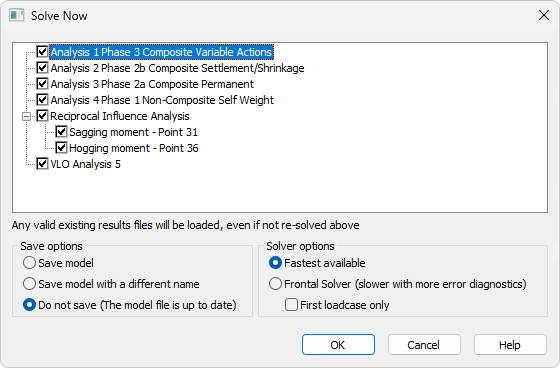
- Save time by running analyses only where results need updating.
- Update boundary conditions or material properties between successive loadcases or analyses as required.
- The interactive analysis treeview clearly displays all assignments, ensuring full transparency and eliminating any “black box” impression.
Examine what-if scenarios with multiple analysis and branching
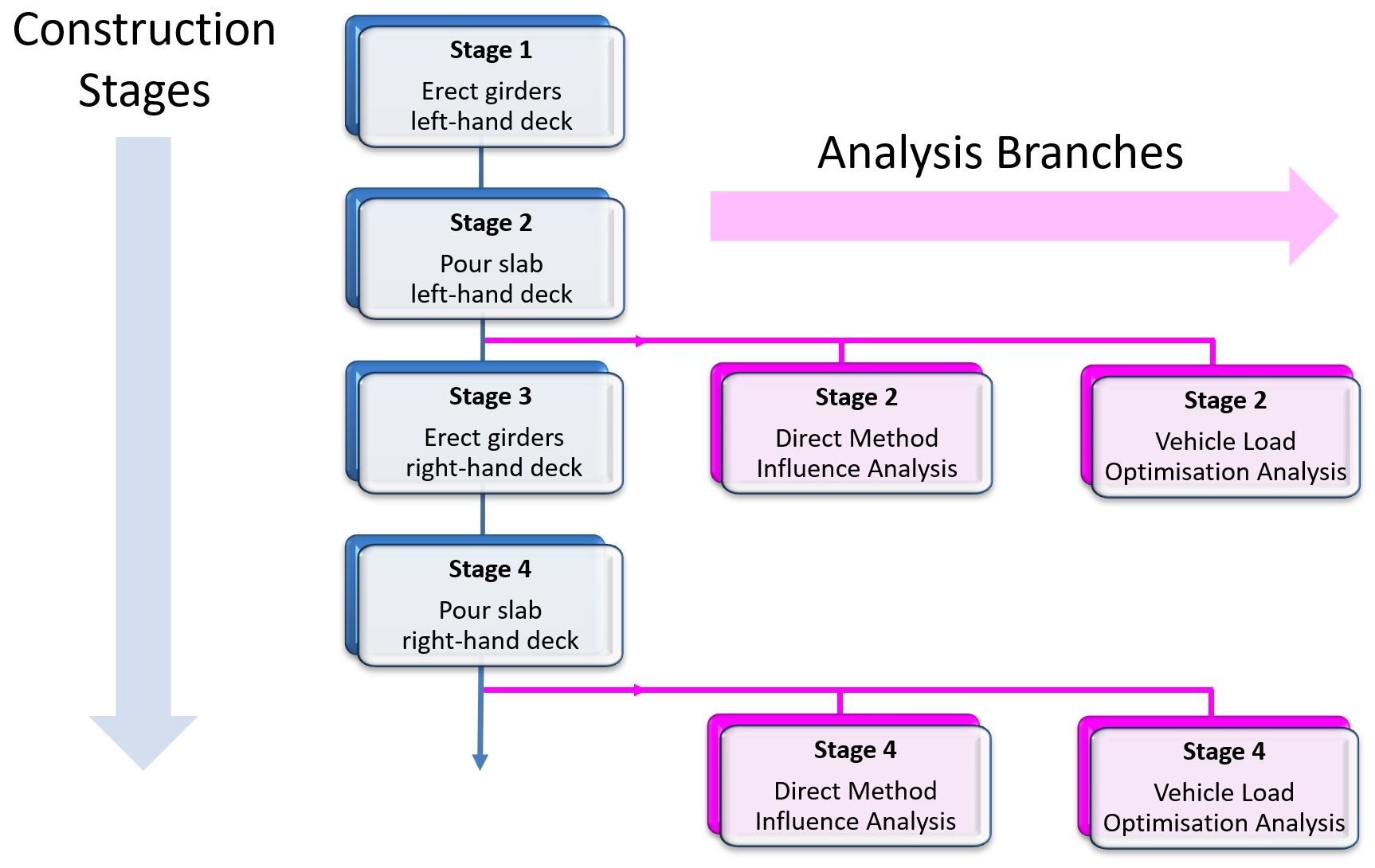
Need to assess different scenarios at a specific stage of your construction sequence?
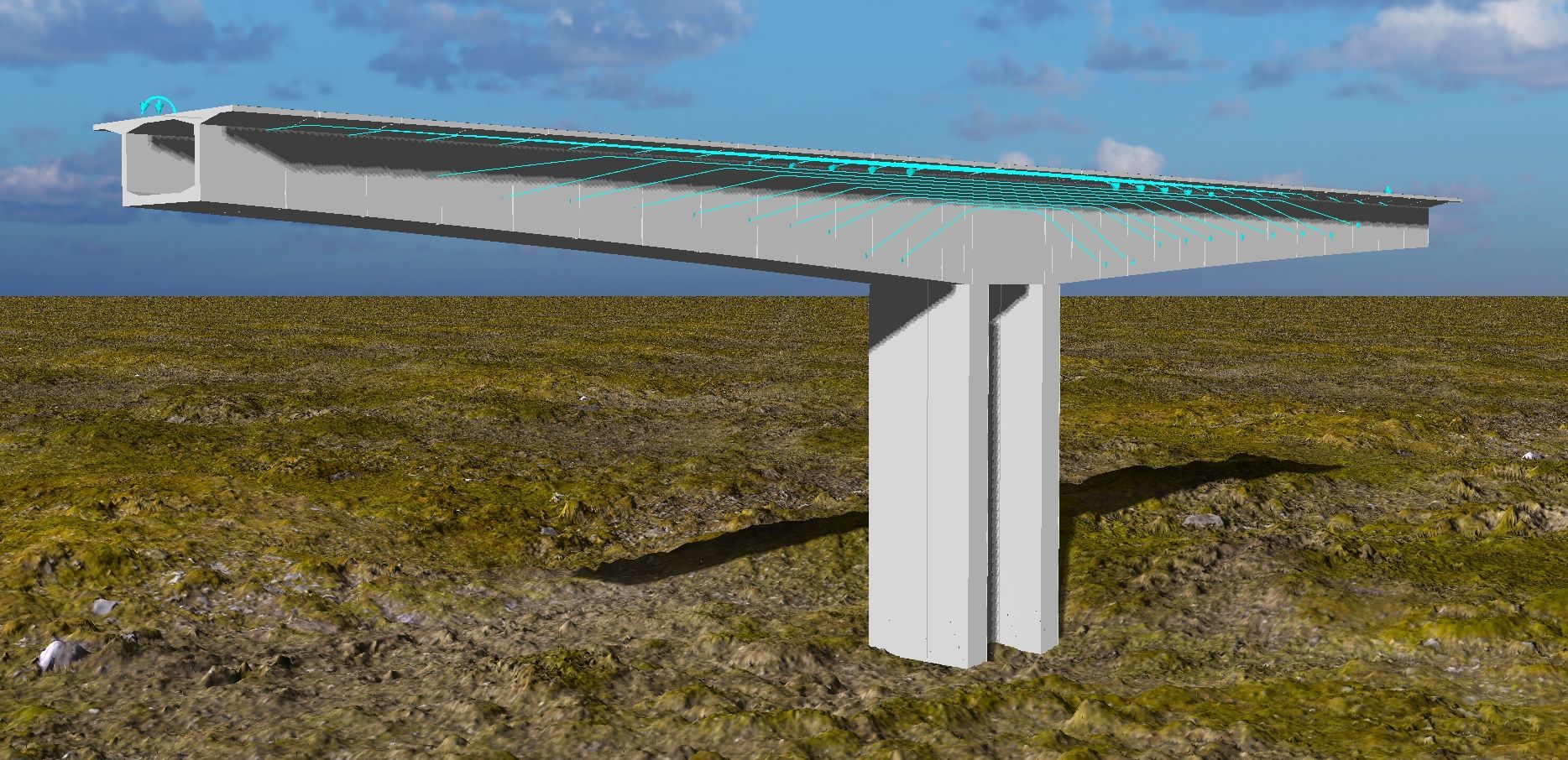
- Explore alternatives with branched analyses, enabling you to investigate specific effects, such as stability or construction loading, at defined points in the sequence.
Include the following specialised analyses in an analysis branch. When done, they will inherit all attribute assignments from the parent loadcase:
- Direct Method Influence Analysis
- Pedestrian Moving Load Analysis
- Moving Load Analysis
- Vehicle Load Optimisation
- VLO Envelope Run
- Rail Load Optimisation
- RLO Envelope Run

Fast and trusted solutions
- We put a lot of effort into the quality of our solvers. They are the "engine" of our products and used in every release to stringently test against industry and internal examples.
- You can trust in us to give you the right result.
Fast Solvers explained
The Fast Solvers software option comprises a number of solvers, which speed-up solution times for all LUSAS software products.
- The Fast Multifrontal Direct Solver can provide solutions several times faster than the standard Frontal Direct Solver for certain analysis problems.
- The Fast MultiFrontal Block Lanczos Solver Eigensolver can, similarly, return results several times faster than the standard Frontal Eigensolvers for certain problems.
- The Complex Eigensolver provides efficient solutions for large-scale damped natural frequency problems.
- The Fast Parallel Direct Solver and the Fast Parallel Iterative Solver will solve large sparse symmetric and non-symmetric equations on shared memory multiprocessors.
The Fast Solvers software option is included in all LUSAS software products for new sales from Version 18 onwards. Contact sales@lusas.com for more details.
Fast Multifrontal Solver
The Fast Multifrontal Direct Solver can provide solutions several times faster than the standard Frontal Direct Solver for certain analysis problems.
The Fast Multifrontal Direct Solver is an implementation of the multifrontal method of Gaussian Elimination, and uses the modern sparse matrix technology of assembling a global stiffness matrix where only the non-zero entries are stored. The solver can be used for almost all types of analysis, and has extensive pivoting options to ensure numerical stability, especially for symmetric problems. It is particularly fast at solving large 3D solid models.
The solver employs powerful reordering algorithms that minimise the amount of extra non-zero entries that are created during the elimination process (known as fill-in entries). As a result, the disk space requirements are typically 75% less than that of the standard frontal direct solver. An advanced out-of-memory facility means that problems which exceed the memory capabilities of the machine can still be solved.
A data check facility is provided and a resolution facility, as with the standard Frontal Direct solver, enables you to rerun linear analyses with different loadcases without having to eliminate the stiffness matrix. Various checks are made to see if the solution vector has been corrupted by round-off error, and warnings are issued accordingly. An estimate of the condition number of the matrix is also computed, so that the relative error in the solution (with respect to machine precision) can be predicted. The solver also recognises negative and near-zero pivots, and will give diagnostic warning messages in each case relating to a particular node and variable in the model.
Fast Multifrontal Block Lanczos EigenSolverestion
The Fast Multifrontal Block Lanczos Eigensolver is based on the Shift and Inverse Block Lanczos algorithm, and solves natural frequency, vibration and buckling problems with real, symmetric matrices. It is very fast, extremely robust, and ensures that convergence is almost always achieved.
You can specify the lowest, highest or a range of eigenvalues to be returned, along with the normalised eigenvectors and error norms which are currently given with the standard Frontal Eigensolvers. The Fast Multifrontal Block Lanczos Eigensolver is based on the same underlying technology as the new Fast Multifrontal Direct Solver and has the same pivoting options, error diagnostics and out-of-memory facilities. An internal Sturm sequence check is performed to verify that the eigenvalues returned are those requested, and you can specify combinations of eigenvalues to be returned in the same analysis, as for example, the highest three eigenvalues can be specified, followed by the lowest ten, and all those in the range 0 to 50.
Complex Eigensolver
The complex eigensolver is non-symmetric eigen solver based on an implicitly restarted Arnoldi method. It provides solutions to damped natural frequency problems for both solid and fluid mechanics. It can solve large scale problems with real, non-symmetric input matrices (in particular, those involving non-proportional damping), and gives solutions that consist of complex numbers where appropriate.
Fast Parallel Direct Solver and Fast Parallel Iterative Solver
These solve large sparse symmetric and non-symmetric equations on shared memory multiprocessors.